
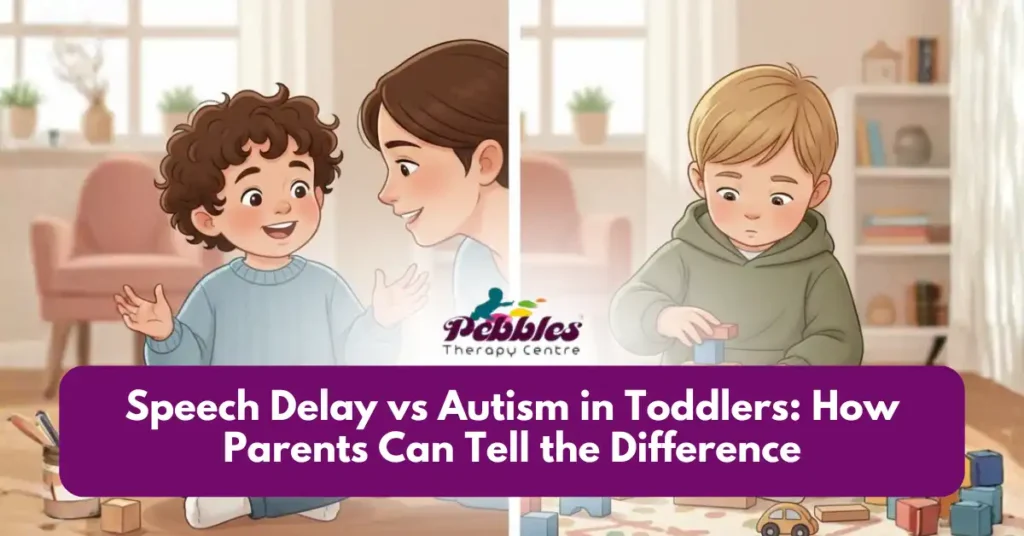
Speech Delay vs Autism in Toddlers: How Parents Can Tell the Difference
Speech Delay vs Autism in Toddlers: For many parents, concerns about speech don’t begin with a dramatic moment. They begin quietly. A toddler who understands everything but doesn’t speak much. A comparison at the park. A casual comment from a relative that lingers longer than expected.
Over time, that small doubt grows into a heavier question — is this just a speech delay, or could it be autism?
Understanding speech delay vs autism in toddlers is important because these two conditions are often confused, especially in the early years. While both can affect communication, they are not the same, and they don’t mean the same thing for a child’s development. This article explains the differences using real-life observations parents notice at home, not medical jargon or online panic.
What Is Speech Delay in Toddlers?

In everyday situations, speech delay in toddlers usually becomes noticeable when parents feel their child understands far more than they can express. The toddler may follow instructions, react emotionally, and show clear preferences — yet spoken words remain limited.
Many parents describe it this way: “He knows exactly what I’m saying, but he just won’t talk.” That observation matters. In speech delay, the desire to communicate is usually present. The words are missing, not the connection.
Speech delay mainly affects how a child uses words and sounds. Vocabulary may grow slowly. Word combinations may come later than expected. Some toddlers also struggle with clarity of speech sounds. What usually remains intact is social engagement — eye contact, play, emotional bonding, and interest in people.
Speech development with speech therapy is not linear. Some children speak early, others take time. A delay does not automatically mean something serious is wrong, especially when social interaction is strong.
Common Signs of Speech Delay in Toddlers
Speech delay rarely appears overnight. Parents often notice it during everyday moments — while playing, reading, or trying to get their child’s attention.
Common signs include:
- Fewer spoken words compared to other children the same age
- Difficulty combining two words by around two years
- Using pointing, pulling, or sounds instead of words
- Understanding instructions but not responding verbally
- Frustration or tantrums during communication attempts
At the same time, many reassuring signs are often present:
- Consistent eye contact
- Responds when name is called
- Enjoys interaction with parents and siblings
- Uses gestures like waving or pointing
- Engages in pretend or imaginative play
These social behaviors are one of the strongest indicators that speech delay is different from autism.
Causes of Speech Delay in Toddlers
Speech delay can happen for many reasons, and in most cases, the cause is not serious or permanent.
Common causes include:
- Hearing difficulties or repeated ear infections
- Oral-motor coordination challenges
- Limited back-and-forth conversation at home
- Excessive screen exposure
- Premature birth or early medical complications
In multilingual families, toddlers may take slightly longer to begin speaking as they process more than one language. This is a normal variation and not a disorder. With the right support and stimulation, most children with speech delay show steady improvement.
What Is Autism in Toddlers?
Autism in toddlers does not always look the way people expect. Some children are quiet. Some speak a few words. Others may even talk early. What stands out over time is not just speech, but how the child connects with people and responds socially.
When comparing speech delay vs autism in toddlers, autism affects social communication, interaction, and behavior together. Language challenges are usually part of a broader developmental pattern that includes difficulty with shared attention, imitation, and flexible play.
Autism exists on a spectrum. Signs and severity vary widely from child to child. This is why autism cannot be identified based on speech alone.
Early Signs of Autism in Toddlers
Early signs of autism usually relate to social connection rather than vocabulary size.
Common early signs include:
- Limited or inconsistent eye contact
- Poor response to name
- Rarely pointing or showing objects to others
- Reduced interest in social play
- Difficulty imitating actions or sounds
Additional behaviors may include:
- Repetitive movements such as hand flapping or spinning
- Lining up toys instead of playing with them
- Strong reactions to sounds, textures, or lights
These patterns together often help professionals distinguish autism from isolated speech delay.
How Autism Affects Communication
Autism affects social communication — how language is used to connect with others. A toddler may speak but struggle to use words meaningfully to share experiences or emotions.
Some children repeat words without understanding, avoid gestures, or struggle with joint attention. Pretend play may be limited or absent. These differences are social in nature, not just speech-based, which is why autism requires a broader developmental approach.
Speech Delay vs Autism in Toddlers – Key Differences
The clearest way to understand speech delay vs autism in toddlers is to look beyond speech and observe interaction. Speech delay affects how a child talks. Autism affects how a child connects.
Key differences include:
- Speech delay: strong interest in people, limited words
- Autism: reduced social engagement
- Speech delay: gestures and eye contact present
- Autism: joint attention often limited
- Speech delay: flexible, imaginative play
- Autism: repetitive or restricted play patterns
Looking at the whole child — speech, play, behavior, and interaction — provides clarity.
Can a Toddler Have Both Speech Delay and Autism?
Yes, a toddler can have both speech delay and autism. Speech delay is often one of the earliest concerns noticed in autistic children, but it is never enough on its own for diagnosis.
In real assessments, professionals do not rely on a single checklist. They observe play, interaction, communication style, and responses over time. This approach prevents misinterpretation and ensures the child receives appropriate support.
When Should Parents Be Concerned?
While development varies, certain signs suggest it is better to seek guidance than to wait.
Red flags include:
- No babbling or gestures by 12 months
- Few or no words by 18 months
- No two-word phrases by 24 months
- Limited eye contact or social interest
- Loss of previously acquired words
Early evaluation brings clarity and peace of mind.
How Is the Difference Diagnosed?
Professionals diagnose speech delay vs autism in toddlers through observation, play-based interaction, and developmental screening. Speech therapists assess expressive and receptive language, while developmental specialists focus on social communication and behavior.
Parents play a crucial role by sharing everyday observations. Diagnosis is not about labels — it is about understanding how to support the child.
Why Early Intervention Matters
Early intervention simply means offering support at the right time, when a child’s brain is still highly adaptable. During the toddler years, communication and social pathways are developing rapidly, and small changes can have a big impact.
For speech delay, early intervention reduces frustration and supports language before difficulties affect behavior or learning. For autism, it focuses on building foundational skills such as joint attention and functional communication.
Early support does not mean lifelong therapy. Many children make steady progress with timely guidance.
What Parents Can Do at Home

Parents influence communication more than they often realize. Therapy sessions may be limited, but learning happens every day.
Helpful strategies include:
- Talking through daily routines
- Reading picture books slowly and interactively
- Encouraging turn-taking games
- Reducing screen time
- Giving the child time to respond
Consistency matters more than perfection.
Speech Delay vs Autism in Toddlers – Final Takeaway
Speech delay affects language timing. Autism affects social communication and behavior. Social connection is the key difference. Early understanding helps families move forward with confidence rather than fear.
Support for Toddlers at Pebbles Therapy Centre
At Pebbles Therapy Centre, many parents arrive asking the same question — “Is this just a speech delay, or something more?” The focus is always on understanding the child first, not rushing to labels.
Through observation, play-based assessment, and parent discussion, families receive guidance tailored to their toddler’s needs. Parents from Anna Nagar and Chrompet can access early intervention, speech therapy, and developmental support during the most important years.
FAQs
Yes. When a toddler is not talking much, the two can look similar at first. Social interaction, eye contact, and shared attention usually help differentiate speech delay from autism.
No. Some children with autism develop speech on time but struggle with social communication.
Some mild delays improve naturally, but it is difficult to predict which children will catch up without support.
Most toddlers say first words by 12 months and combine words by 24 months.
No. Exposure to more than one language does not cause speech delay or autism.